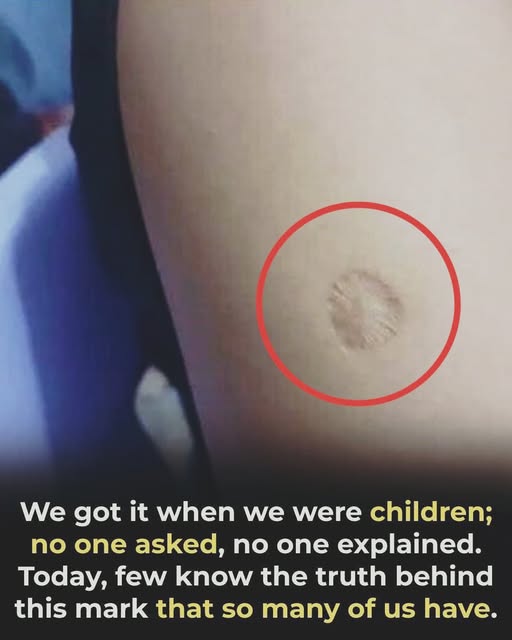
That Small Round Scar on Your Upper Arm Might Be Carrying a Piece of History
I never paid much attention to it growing up.
A small round scar on my mother’s upper arm—faint, circular, easy to overlook. It sat there like any other old mark, part of the background of childhood. Familiar enough that I stopped noticing it. Continue Reading ⬇️
Years later, in a completely unrelated moment, I saw that same scar again.
I was helping an older woman step down from a train when her sleeve shifted slightly. There it was—same place, same distinct shape. Small, round, unmistakable.
And instantly I thought of my mother.
I never asked the woman about it, but later that day I called my mother and finally asked the question I’d carried quietly for years.
Her answer was simple:
“It’s from the smallpox vaccine.”
A Small Mark Many People Share
For many adults born before the early 1970s in the United States—and in similar periods in other countries—that small round scar on the upper arm comes from a smallpox vaccination.
For some people it’s barely visible now. For others it remains clear decades later.
Many carry it without thinking about it.
And yet it marks something much larger than one injection.
Why Smallpox Was Once So Feared
Smallpox was once one of the most dangerous infectious diseases in the world.
It often began with fever, body aches, exhaustion, and weakness. Then came the rash—followed by painful skin lesions that spread across the body. Many people were left permanently scarred. Many did not survive.
Entire communities feared outbreaks.
Families lived with uncertainty that today feels hard to imagine.
Before widespread vaccination, smallpox was not rare history—it was an immediate human threat.
How the Vaccine Left Its Mark
Unlike most modern vaccines, the smallpox vaccine was given using a unique technique.
A special two-pronged needle was used to lightly puncture the skin multiple times in one small area. That process triggered a visible skin reaction that typically followed a pattern:
- a small bump appeared
- it became a blister
- the blister dried and formed a scab
- after healing, a round scar often remained
Because the upper arm was commonly used, many people ended up with nearly identical marks in nearly the same place.
A small scar—but a recognizable one.
The Quiet Victory Behind It
Smallpox is now considered one of public health’s greatest victories.
Through widespread vaccination efforts across countries and generations, the disease was gradually pushed back until transmission stopped completely.
In 1980, the World Health Organization officially declared smallpox eradicated.
It became the first human disease eliminated worldwide through coordinated global action.
That’s a remarkable thing to pause and think about.
A virus once feared across continents… now gone.
And for many people, the only trace left behind is a small circle on the arm.
More Than a Scar
What once looked like an ordinary skin mark now feels different to me.
Less like a scar.
More like a reminder.
A reminder of a time people lived through that younger generations only read about.
A reminder of medicine, resilience, and what communities can do when people work toward protecting one another.
And maybe also a reminder that history doesn’t only live in books or museums.
Sometimes it stays quietly with us—in the body, in memory, in the details we stop noticing until one day we see them again with new eyes.
Do you—or someone in your family—have this small circular scar? Sometimes the smallest marks carry stories far bigger than they first appear.