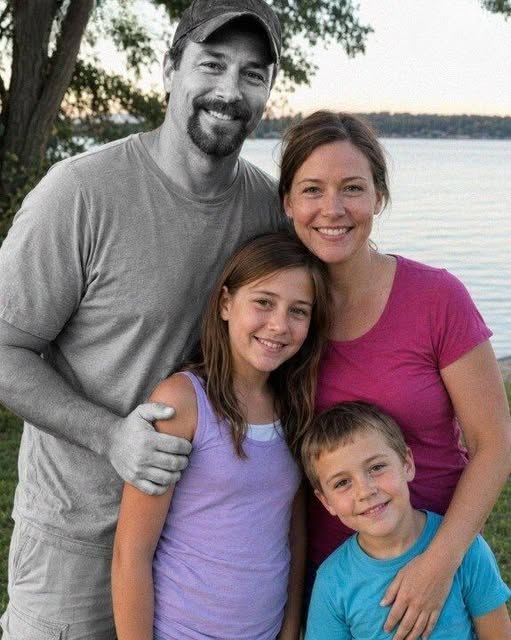
When my husband Jack passed away, we were told it was a tragic workplace accident.
The factory described it as a mechanical failure. The official reports used careful, clinical language that didn’t leave much room for doubt. Everything was categorized, documented, and closed.
But for me, nothing ever felt fully settled.
Jack had worked at that manufacturing plant for over a decade. He knew the machines inside and out, and he rarely made mistakes. Still, I tried to accept what I was told, because grief often leaves little space for questions.
At home, life continued quietly but painfully.
Our daughter Melissa, twelve, tried to understand what had happened, while our younger son David kept asking when his father would come back to fix the things he had left unfinished. Everyday routines felt heavier without him.
It was in those small, ordinary reminders that his absence felt most real.
The Garage Full of Memories
Jack loved the garage. It was his personal workspace, filled with tools, half-finished projects, and quiet routines that brought him comfort.
After the funeral, I avoided it for weeks. Eventually, I began sorting through his belongings, trying to make sense of the space he once spent so much time in.
That’s when I noticed his old red toolbox under the workbench.
It was worn and scratched, something I had suggested replacing years earlier. But Jack had always insisted on keeping it.
He once told me, “There are things I don’t want to lose.”
At the time, I assumed he meant tools or memories attached to his work. After his passing, the meaning of those words felt different.
A Hidden Discovery
Inside the toolbox were the usual items—wrenches, screws, measuring tape, and old notes. But something unusual caught my attention.
The base of the toolbox felt uneven.
After carefully examining it, I discovered a concealed compartment beneath the false bottom.
Inside was an old mobile phone, carefully wrapped in cloth.
I immediately recognized it. It was the phone Jack had replaced nearly a year earlier, the one he said he had lost.
Curious and unsettled, I charged it.
After some time, the device turned on.
The wallpaper was a family photo—one I hadn’t seen in a long time.
I decided to look through the contents.
Most of it was ordinary: pictures of the children, reminders, and work-related notes. But there was one video file dated the night before Jack passed away.
The Final Video
I hesitated before pressing play.
The video showed Jack sitting alone in the garage, speaking directly into the camera. He looked tired and serious, unlike the calm, steady man I remembered.
He said he was leaving a message in case something happened to him.
As the video continued, he spoke about workplace concerns and challenges related to safety and pressure at his job. His tone suggested he had been carrying stress and responsibility privately for some time.
At one point, another person briefly entered the garage, and a tense conversation followed about work-related issues and concerns he had raised internally.
The recording ended abruptly shortly afterward.
I sat in silence for a long time after it stopped.
Searching for Answers
The video raised questions I could no longer ignore. I reached out for legal and professional guidance to better understand what I had found.
Over time, further review of workplace conditions and internal documentation revealed that there had been prior safety concerns reported at the facility. Some employees later confirmed that issues had been discussed internally but not fully addressed.
The investigation into Jack’s accident was reviewed again in light of this new information.
While nothing could change what had already happened, the process helped clarify the circumstances surrounding his final days at work.
What I Learned
In the weeks that followed, I often thought about Jack—not only as a husband and father, but as someone carrying stress and responsibility quietly, trying to protect his family from worry.
I realized how often people do that: they carry burdens alone, believing silence is a form of strength or protection.
But silence can also create distance between what is known and what is left unspoken.
Moving Forward
Life slowly began to settle into a new rhythm.
Melissa and David adapted in their own ways, and we tried to rebuild small routines together. The garage, once a place I avoided, gradually became a space of quiet reflection rather than pain.
Jack’s old toolbox remains where I first found it.
Not as a source of mystery anymore, but as a reminder of the complexity of the people we love—how much of their inner world can remain unseen, even by those closest to them.
Final Thoughts
This experience taught me that understanding someone’s life is not always complete while they are still here. People often carry thoughts, concerns, and responsibilities they don’t fully share.
Sometimes we only begin to understand those hidden parts afterward, through the things they leave behind.
In the end, what I found wasn’t just a phone or a video.
It was a reminder of how important communication, awareness, and connection truly are—especially with the people who matter most.