How to Untangle a Knotted Chain Without Damaging It
The Frustration of a Tangled Chain
Chains are widely loved accessories because they are simple, versatile, and easy to incorporate into everyday style. They can be worn around the neck, wrapped around the wrist, or even used as subtle accents around the ankle.
Despite their elegance, chains often create frustration for their owners when they become tangled. One moment they are neatly stored or ready to wear, and the next they have twisted into tight knots that seem impossible to loosen without causing damage.
At first glance, a knotted chain may appear ruined, especially when the links are small or the knot is tightly compressed. However, most tangles can be resolved successfully with patience, proper lighting, and a careful approach that avoids force.
The key principle throughout the entire process is to avoid panic. Pulling or tugging aggressively can tighten the knot further, bend delicate links, or even break the chain completely. A calm mindset is the foundation of safe and effective untangling.
Starting With Patience and Control
Before attempting to touch or loosen a knot, it is important to slow down and approach the situation with care. Untangling a chain is rarely a task that requires strength, but rather one that requires precision and patience.
When frustration takes over, the instinct is often to pull quickly in hopes of forcing the knot apart. Unfortunately, this usually has the opposite effect and tightens the tangled sections even more.
A more effective approach is to treat the task as a delicate repair process. Every movement should be slow and intentional, allowing time to observe how the links respond. Even tightly bound knots can often be eased apart gradually when handled carefully.
Maintaining patience also protects the structure of the chain itself. Many chains are made from fine metal links that can bend or weaken under sudden pressure. Gentle handling preserves both the appearance and durability of the accessory.
Creating the Right Workspace
A well-prepared workspace plays a major role in successfully untangling a chain. Good lighting is especially important because it allows you to clearly see how the links overlap and where the knot begins.
Natural light is ideal when available, as it highlights even the smallest details within the tangle. Placing the chain near a window can reduce shadows and make the structure of the knot easier to understand.
If natural light is not available, a bright artificial lamp can serve the same purpose. The goal is to ensure that the knot is fully visible without dark areas hiding important details.
A stable, clean surface is also essential. A table, desk, or countertop provides a controlled area where the chain will not slip or fall. This stability helps prevent additional tangles while you work.
A properly lit and organized workspace may seem like a minor detail, but it often determines whether the knot becomes easier or more complicated to resolve.
Laying the Chain Flat Before Working
Once a suitable workspace is prepared, the chain should be laid flat on the surface. Spreading it out helps reveal its full structure and separates the actual knot from simple twists.
Many chains appear more tangled than they truly are because loose ends overlap or curl around themselves. In reality, only a small section may be responsible for the entire problem.
It is important not to begin by pulling on both ends of the chain. Instead, the chain should be gently arranged so that it lies as naturally as possible. This helps isolate the knot and prevents unnecessary tightening.
Laying the chain flat also reduces the chance of creating new tangles during the process. When the chain is supported evenly on a surface, it remains more stable and easier to manage throughout the untangling process.
Taking time at this stage improves every step that follows, since a clear layout makes it easier to understand how the knot is formed and how it can be released.
Understanding the Structure of the Knot
Not all knots behave the same way. Some are loose loops that can be separated with minimal effort, while others are compact and tightly woven between multiple links.
Before using any tools, it is important to closely observe the knot and identify how it is formed. Locating where the chain enters and exits the tangled area can help determine the best starting point.
Loose knots often respond well to gentle finger movements. Carefully lifting a loop and creating space within it can sometimes allow the chain to slide free on its own.
Tighter knots require more caution. Instead of pulling the ends, it is usually more effective to work from the center of the knot and gradually loosen it outward. Forcing the ends often makes the knot more compact and difficult to manage.
Understanding the type of knot allows for better decision-making and reduces the risk of damage during the process.
Using a Pin or Needle for Precision
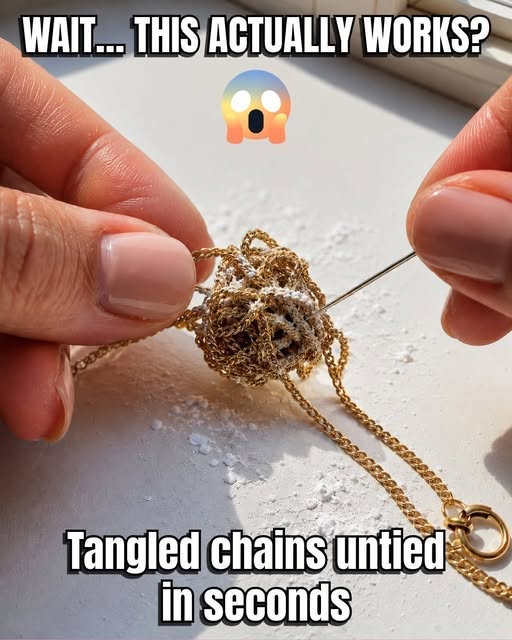
When a knot is too tight to loosen with fingers alone, a straight pin or needle can provide the precision needed to begin opening it. These tools can reach small gaps between links that would otherwise be inaccessible.
The pin should be inserted gently into the center of the knot. The goal is not to pierce or force the chain, but to create small openings between tightly packed links.
Slow and careful movements are essential during this step. By shifting the pin slightly and lifting small sections, it becomes possible to gradually introduce space within the knot.
The chain should remain flat on the surface while this process is carried out. This helps maintain control and reduces the risk of sudden tightening.
As soon as the knot begins to loosen, it may become easier to continue with fingers instead of tools. Transitioning slowly between methods helps maintain control and prevents damage.
Applying Lubrication for Stubborn Knots
In some cases, knots remain tightly locked even after careful manipulation. When this happens, a very small amount of lubrication can help reduce friction between the links.
A single drop is usually sufficient. Applying too much can make the chain slippery and difficult to control, so moderation is important.
Once applied, the lubricant should be allowed to sit briefly so it can settle into the tight areas of the knot. This helps loosen friction points between the links.
After waiting, gentle movement can be applied again. In many cases, the chain will begin to shift more freely, making it easier to separate the knot without force.
Care should always be taken to avoid overusing lubrication. The goal is only to assist movement, not to saturate the chain or surrounding workspace.
Using Tweezers or Pliers for Greater Control
When knots are too small or complex for fingers alone, tweezers or needle-nose pliers can provide improved control. These tools allow for more precise manipulation of individual links.
The tool should be used to gently hold sections of the chain near the knot. Excessive pressure should be avoided, as it can flatten or damage delicate links.
Small back-and-forth movements can help loosen the knot gradually. These subtle adjustments often prove more effective than larger, forceful actions.
It is important to pause if the tool feels too tight or begins to slip. Repositioning the grip can prevent accidental damage and improve control over the process.
Even with tools, patience remains essential. The goal is to gradually release tension in the knot rather than force it apart quickly.
Taking Breaks to Maintain Focus
Untangling a chain can sometimes take longer than expected, especially when knots are dense or complicated. When frustration begins to build, stepping away briefly can be very helpful.
A short break allows the mind to reset and often provides a clearer perspective when returning to the task. What once seemed impossible may become easier to understand after a pause.
Breaks also help prevent mistakes caused by impatience. Pulling too hard or rushing through steps can increase the risk of damaging the chain.
There is no need to complete the process in one attempt. Slow, careful progress is still successful as long as the chain remains intact.
Preventing Future Tangles
Once the chain has been successfully untangled, proper storage becomes important to prevent future knots from forming. Careful storage habits can significantly reduce the likelihood of repeated tangling.
Storing chains separately is one of the most effective methods. When multiple chains are kept together, they can easily twist around each other and form complex knots.
Hanging chains is another useful option, as it allows them to remain straight and free from overlapping. This reduces unnecessary bending and twisting over time.
Individual compartments or separate containers also help keep chains organized and protected. This prevents them from rubbing against other items and forming unwanted loops.
Ensuring that a chain is not already twisted before storage can also make a difference. Even small twists can tighten over time and develop into full knots later.
A Careful Approach That Preserves Your Chain
A knotted chain can be frustrating, but it does not have to result in permanent damage or loss. With patience, attention, and a structured approach, most tangles can be resolved safely.
The process begins with preparation, including a well-lit workspace and a flat surface. From there, careful observation of the knot helps determine the best method for loosening it.
Simple tools such as pins, tweezers, or pliers may assist when fingers are not enough, while small amounts of lubrication can help reduce friction in stubborn cases.
Throughout every stage, patience remains the most important factor. Moving slowly protects the chain and ensures that each adjustment contributes to loosening rather than tightening the knot.
Once the chain is free, proper storage helps preserve its condition and reduces the likelihood of future tangles. With consistent care, chains can remain smooth, wearable, and ready for use at any time.
Although untangling a chain may seem like a small challenge, it is one that rewards calm thinking and careful handling. With the right approach, even the tightest knot can often be restored to a wearable state.