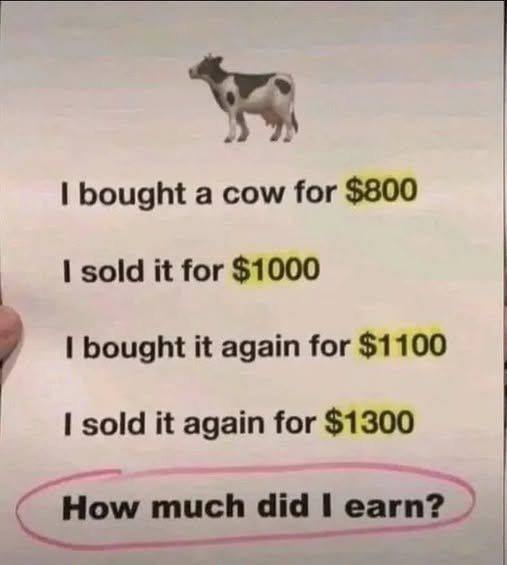
It starts with a cow and four clean numbers: 800, 1,000, 1,100, 1,300. No fees, no interest, no fine print. Just two buys and two sells. The trap isn’t in the math; it’s in how our brains try to juggle every step at once, turning a tidy problem into a mental blur. People rush to compress it into one “big” equation, or assume the second deal somehow cancels the first. That’s when confident guesses like $0 or $200 start flying around.
The puzzle only clears up when you slow it down. Treat each buy-and-sell as its own mini-story: first, spend $800 and get back $1,000—$200 ahead. Then spend $1,100 and receive $1,300—another $200. Put them together and you’re up $400. Same result if you zoom out: $1,900 spent, $2,300 earned, difference $400. The real twist isn’t the answer. It’s how easily a simple sequence can shake our certainty—and how quickly calm, step‑by‑step thinking restores it.