It was always just the two of us. My father, Johnny, was a man of simple needs and immense heart. My mother had died giving birth to me, leaving Dad to navigate the world of pigtails, school lunches, and bedtime stories alone. He was the janitor at my school, a job that came with a side of cruelty from my peers. I grew up hearing the whispers: “That’s the janitor’s daughter. Her dad scrubs our toilets.” I never let them see me cry, but Dad always knew. He’d just tell me that people who try to feel big by making others feel small aren’t worth much thought.
When Dad was diagnosed with cancer during my junior year, his only goal was to see me go to prom. “I want to see you walk out that door like you own the world, princess,” he’d say, even as he leaned against his mop for support. He didn’t make it. He passed away a few months before the dance, leaving me with nothing but a box of his old work shirts and a hollow space in my chest.
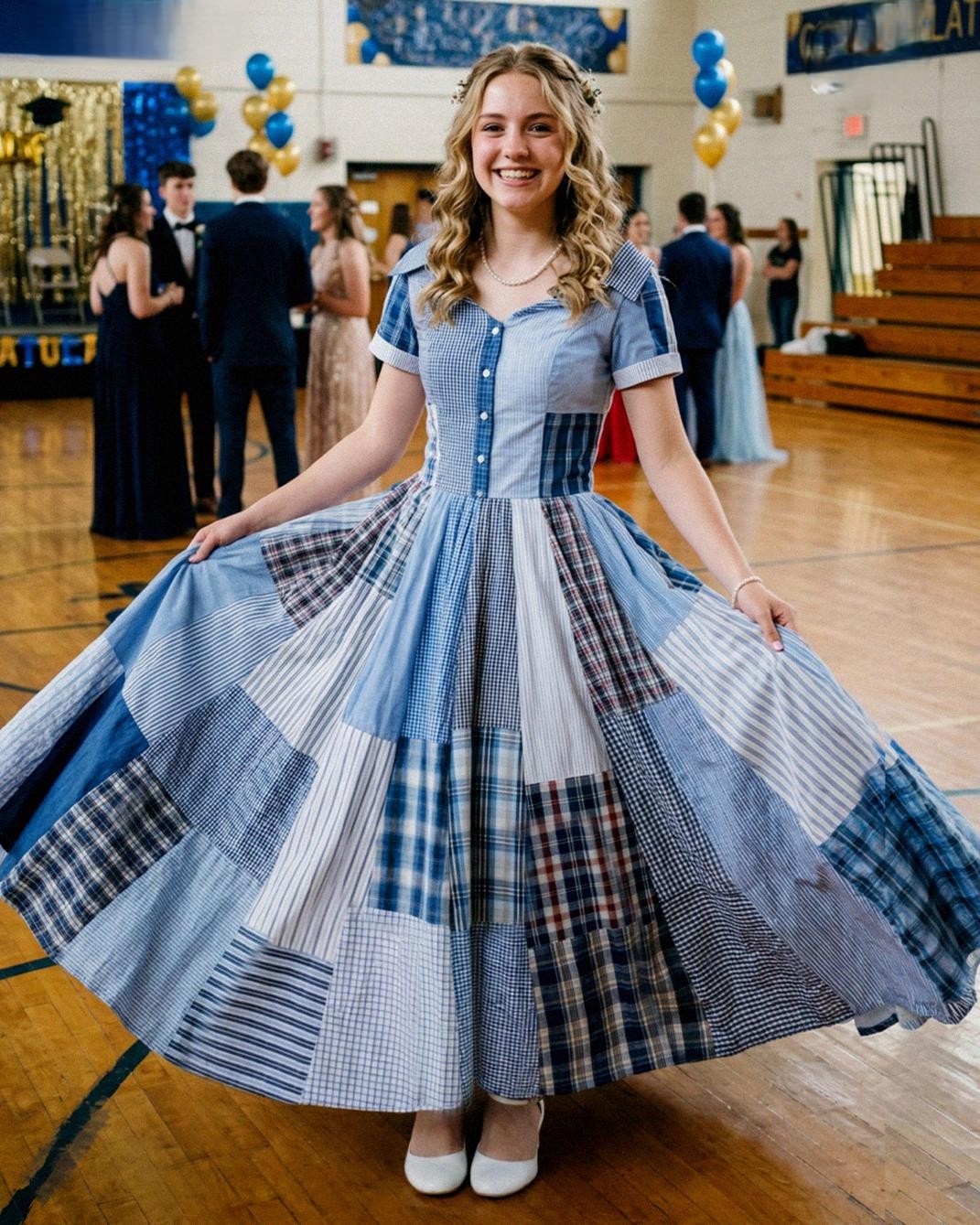
Prom season arrived with its usual frenzy of designer labels and luxury cars. I felt completely detached until I looked at those shirts—the blue ones, the grays, and the faded green one he wore the day he taught me to ride a bike. I realized that if he couldn’t be there to take photos, I could carry him with me. My Aunt Hilda helped me deconstruct his wardrobe, stitching together a dress that was a literal catalog of my life with him. Every seam was a memory; every panel of fabric was a hug I could no longer receive.
The night of prom was electric, but the mood soured the moment I stepped into the venue. The whispers started instantly. “Is that dress made from janitor rags?” a girl laughed loudly. A boy nearby joined in, asking if I was too poor to afford a “real” dress. The laughter rippled through the crowd, creating a cold, mocking gap around me. My face burned as I tried to explain that it was a tribute to my father, but they only rolled their eyes. “Nobody asked for the sob story!” someone shouted. I retreated to a corner, fighting back tears, feeling like the 11-year-old girl who had been teased for her father’s profession all over again.
Suddenly, the music cut out. Our principal, Mr. Bradley, stood in the center of the floor with a microphone. The room fell into an uneasy silence. “I want to tell you something about the dress Nicole is wearing,” he began, his voice steady and stern.
He told the room about Johnny—not as a janitor, but as the man who stayed late to fix broken lockers so students wouldn’t lose their gear. He spoke about how my father had secretly sewn torn backpacks for kids who couldn’t afford new ones and washed sports uniforms so no athlete felt the shame of poverty. “Many of you benefited from his kindness without ever knowing it,” Mr. Bradley said. “This dress isn’t made of rags. It is made of the shirts of the man who cared for this school and every one of you for over a decade.”
Then, he issued a challenge: “If Johnny ever fixed something for you, helped you, or did something you didn’t notice at the time, please stand.”
A teacher stood first. Then a star athlete. Then another, and another. Within a minute, more than half the room was on its feet in a silent, powerful tribute. The classmates who had mocked me sat frozen, staring at their hands in sudden, heavy shame. The laughter was gone, replaced by a wave of applause that felt like a shield. I wasn’t the janitor’s daughter anymore; I was the daughter of a hero. I had made my promise to make him proud, but standing in that room, I realized he had already made me proud enough for a lifetime.