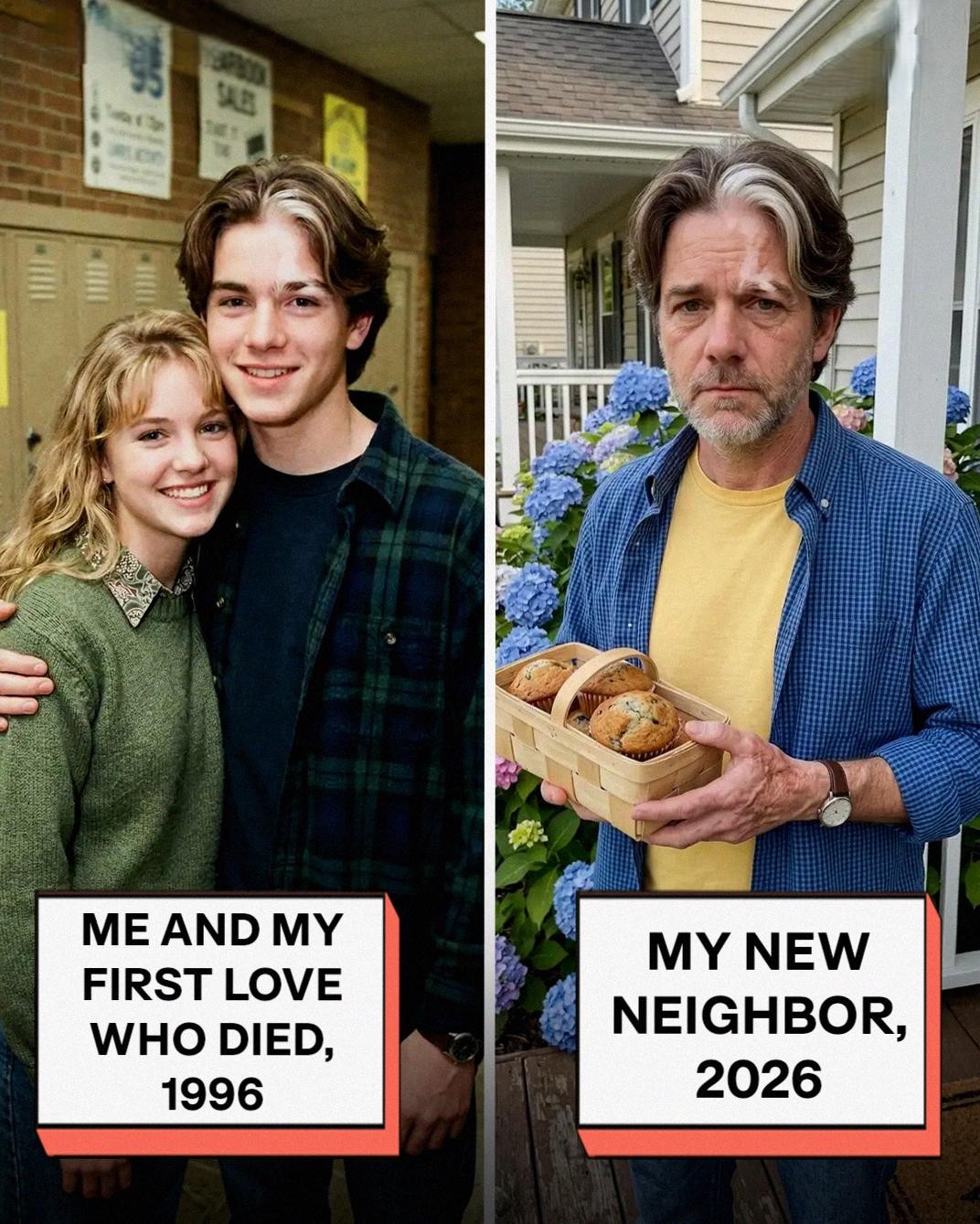
If I hadn’t been so stubborn about my hydrangeas, I never would have seen the dead man move in next door. A moving truck sat in the driveway, an ordinary sight in a quiet suburb, until the driver stepped out. He moved with a heavy, familiar tilt, a way of rushing toward the world that I had buried thirty years ago. I spent three days hiding behind my curtains, convinced that grief had finally fractured my sanity. I stared at my old yearbook, tracing the jawline of a boy named Gabriel who had supposedly perished in a house fire three decades prior.
On the fourth morning, a knock came—slow and deliberate. I opened the door to find a man introducing himself as Elias. But as he reached out a basket of muffins, his sleeve slid back. The skin was tight and shiny, evidence of extensive skin grafts. Beneath the burn tissue was a distorted, ink-stained scar in the shape of an infinity symbol. It was the matching tattoo we had gotten together as teenagers.
“Gabe?” I whispered, the name feeling like a prayer. His smile faded instantly. He confessed that he hadn’t intended for me to recognize him, but that I deserved the truth. The fire thirty years ago hadn’t been an accident. Gabriel’s mother, Camille, had orchestrated a horrific deception to separate us, believing a mechanic’s daughter was beneath her family’s status. They had used dental records to misidentify remains and spirited Gabriel away to Switzerland under the guise of post-traumatic amnesia and burn recovery.
For thirty years, Gabriel lived as Elias, a ghost of himself kept under the strict surveillance of private nurses and family lawyers. Every time he tried to run or remember his past, the rules would change, or he would be told I had moved on and forgotten him. Camille had controlled his medical records, his finances, and his very identity. But now, Gabriel had finally regained control of his documents and escaped the gilded cage his mother had built.
The confrontation came sooner than expected. Camille’s black sedan rolled into the cul-de-sac just as Gabriel and I were talking on the lawn. She stepped out, radiating the same cold authority I remembered from my youth. She tried to play the role of a concerned mother, warning me to stay away from her “unstable” son. She threatened that if I didn’t back off, Gabriel would vanish again.
But I wasn’t the intimidated girl I once was. “I know exactly who he is, Camille,” I said, meeting her gaze. Gabriel stood beside me, his shoulders square for the first time in decades. He told her he was done being erased. We decided to fight back together, refusing to let her rewrite our history any longer.
With the help of my friend Janet, we gathered the evidence of Camille’s decades-long cover-up. We prepared to expose her to the board of the pharmaceutical company she had kept Gabriel from leading. When we walked into her home to deliver the news of an emergency board session, Camille’s composure finally shattered. She realized that she had underestimated the power of the truth and the endurance of the love she had tried to burn away.
As the doors closed on her, Gabriel turned to me and let out a shaky breath. The past no longer owned us. We weren’t just the survivors of a fire; we were the authors of our own next chapter. I squeezed his hand, knowing the fight for his legal identity was just beginning, but for the first time in thirty years, the dead man next door was finally home.