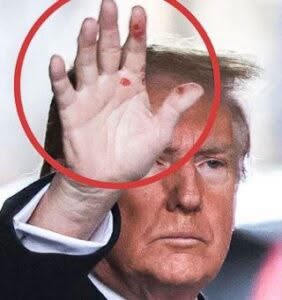
President Donald Trump has once again captured public attention—but this time, it’s not about rallies, courtrooms, or policies. Instead, a series of photos showing noticeable red marks on his hands has ignited widespread speculation, proving that even the smallest detail can dominate headlines when it involves one of the most scrutinized figures in American politics.
The marks first drew attention during recent public appearances, as Trump shook hands with supporters. Sharp reddish patches appeared on his right hand, particularly near the thumb, index finger, and upper palm. The discoloration didn’t seem to be a trick of lighting and appeared consistently across multiple images, prompting social media users to zoom, compare, and debate what might be behind the change.
As is often the case online, theories spread faster than facts. Within hours, timelines were flooded with side-by-side photos, amateur “analyses,” and confident claims from people with no direct insight into Trump’s health or habits. Some dismissed the marks entirely, while others treated them as clues to something more significant.
The explanations ran the gamut. On the lighter side, some joked about everyday mishaps—ketchup spills, hot sauce, or residue from makeup transferred during repeated handshakes. Others humorously blamed household accidents, like burns from irons or irritation from cleaning products. The humor highlighted a key feature of internet culture: turning uncertainty into entertainment.
More provocative suggestions also emerged. A few speculated about possible medical causes, despite having no evidence or professional insight. One political commentator even compared the marks to symptoms of certain conditions, sparking a mix of laughter and criticism. The episode illustrated how quickly health speculation can escalate when attached to a high-profile figure—even when made in jest.
Some observers offered a more grounded explanation: golf. Trump, a long-time enthusiast, often spends hours gripping clubs under sun and wind, a combination that can lead to redness, irritation, or calluses. For those familiar with his routines, this explanation seemed plausible. Repeated friction, dry skin, or sensitivity could easily explain the marks without invoking anything unusual.
Yet without official confirmation, every guess remains speculation. Trump has not addressed the marks publicly, nor has his team released a statement. In the vacuum created by silence, discussion—and controversy—thrives.
This episode is also a reminder of the relentless scrutiny applied to public figures. Every detail—hairstyles, clothing, posture, facial expressions, and now hands—is analyzed and dissected. For Trump, whose style and public presence have long invited attention, this scrutiny is especially intense.
It raises another question: where does curiosity cross the line into intrusion? Red marks on a hand are minor in everyday life, yet here they’ve become a national conversation. Supporters argue such speculation is trivial, even disrespectful. Critics insist that public figures must be transparent, especially those holding or seeking power.
Medical professionals caution against drawing conclusions from photos alone. Skin discoloration can result from countless benign factors: minor injuries, allergic reactions, pressure, temperature changes, or irritation. Without an in-person examination, any assumptions are speculative at best and misleading at worst.
Nevertheless, fascination persists. In a digital era where images travel instantly and are endlessly replayed, small details can dominate discussion. Algorithms amplify curiosity, ensuring that even minor mysteries capture attention.
Whether the red marks are from golf, a minor accident, skin sensitivity, or nothing at all, they have already made an impact. They reveal how easily speculation can overshadow substance, how attention can pivot from policies to puzzles, and how public figures exist under constant, microscopic observation.Until Trump or his team addresses the marks—or until they fade on their own—the conversation will likely continue, resurfacing with every new photo or public appearance. For now, the red spots remain unexplained, overanalyzed, and a perfect example of the modern media environment: where curiosity, humor, suspicion, and speculation collide, and even a hand can become headline news.