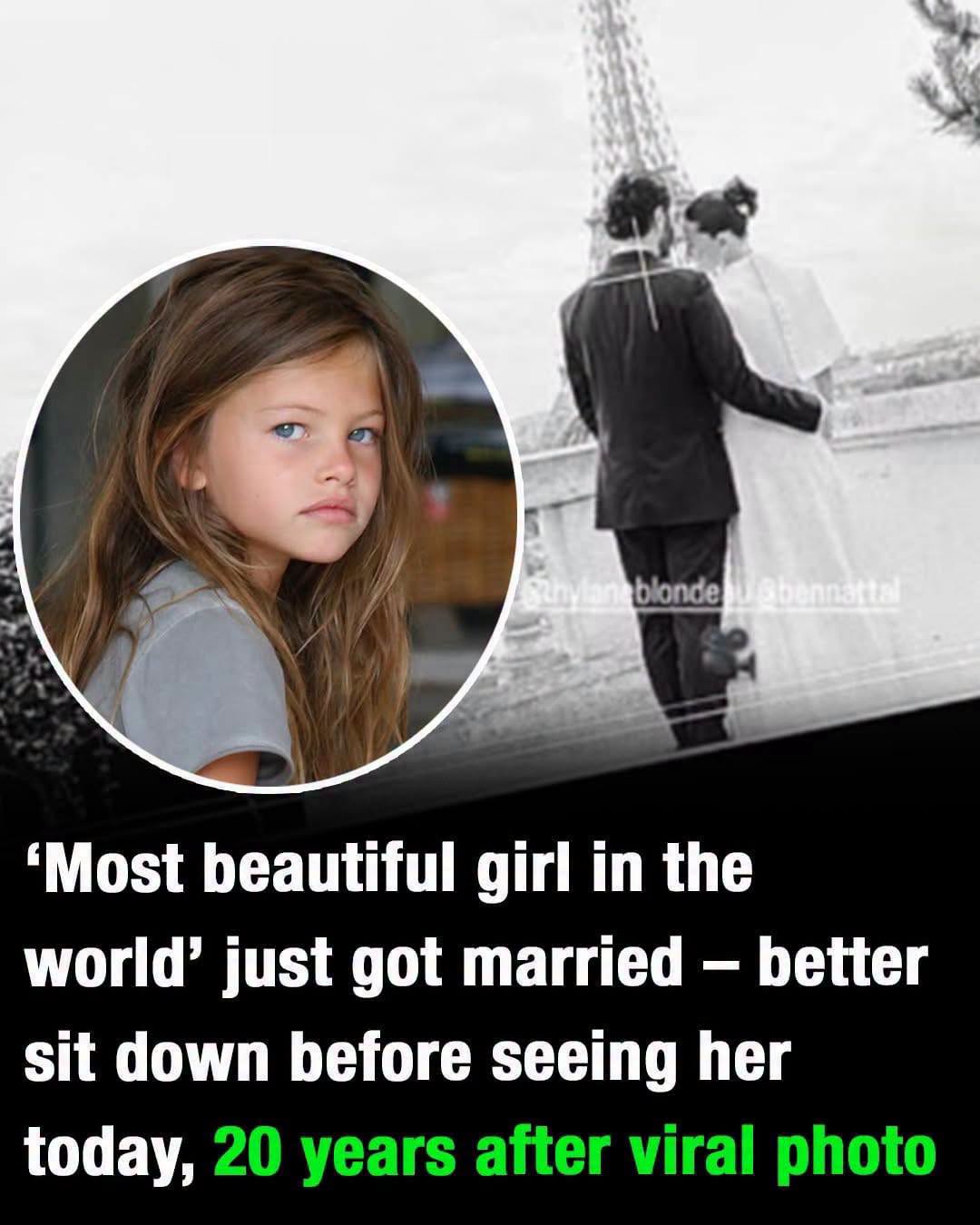
The flashes of cameras have followed her since she was barely old enough to tie her own shoes, but nothing could have prepared the public for this bombshell. She was once branded “the most beautiful girl in the world” by a global media machine that obsessed over her every feature, trapping her in a digital cage of impossible expectations. Now 25, Thylane Blondeau has finally broken her silence in the most spectacular, jaw-dropping way imaginable. In a secret, breathtaking ceremony set against the romantic skyline of Paris, she has officially stepped into a life that belongs entirely, and unapologetically, to her.
For most of her life, Thylane has been a name synonymous with a title she never asked for. At just six years old, her image graced the pages of Vogue Enfants, and in a heartbeat, the world decided how she should look, how she should act, and who she should be. She was thrust into an unforgiving spotlight, her childhood moments cataloged and critiqued by millions of strangers. Every milestone was measured against that singular, superficial label. For years, she navigated the treacherous waters of fame, constantly fighting to prove that there was a beating heart and a complex soul beneath the “most beautiful” moniker.
But in Paris this week, the narrative shifted. In a move that surprised even her most dedicated followers, Thylane stepped out of the shadows of her past and into a town hall, dressed in radiant white, to marry French DJ Ben Attal. There were no elaborate, performative brand deals, no massive press releases, and no orchestrated chaos. Instead, the wedding felt intimate—a quiet, powerful rebellion against the life of public scrutiny she has endured for nearly two decades. The Eiffel Tower stood as a silent witness in the background, a grand monument that seemed almost small compared to the genuine, human connection unfolding in the foreground.
The arrival was vintage elegance personified. The couple pulled up in a stunning platinum Porsche, a scene that looked like something plucked from a classic French film rather than a celebrity gossip column. Yet, looking at them, the spectacle faded away. They didn’t look like icons or stars; they looked like two people who had found a sanctuary in each other—a place where the cameras couldn’t reach, and where the world’s definitions held no power. It was a refreshing, almost jarring shift from the life of constant observation she has always known.
This wedding wasn’t just a union of two people; it was the culmination of a long, arduous journey toward self-possession. Growing up under the microscope of the global fashion industry, Thylane had to learn early on that her image was a commodity owned by others. Every change in her appearance was fodder for headlines, and every personal decision was subject to public debate. To go from that level of intrusion to a life of privacy and intention is a feat of remarkable resilience. By choosing to define her own wedding—a day traditionally marked by high-profile excess—with such personal, understated grace, she has reclaimed her identity.
She has effectively transitioned from being an object of beauty to a subject of her own life. The “most beautiful girl in the world” tag has been replaced by something far more substantial: a woman who understands her own worth. It is a transition from image to intention, from living a life that is seen to living a life that is felt. In the quiet vows exchanged in that Parisian town hall, Thylane didn’t just pledge her love to Ben Attal; she pledged her loyalty to her own happiness.
The weight of the expectations she carried as a child might have crushed someone else. Most child stars, when thrust into such intense global scrutiny, struggle to find an identity that isn’t a reaction to the pressures they’ve faced. Thylane, however, has managed to curate a quiet, steady life beneath the noise. She built a career on her own terms, kept her personal life fiercely guarded, and developed a voice that sounds distinctly like her own. This marriage is the final act of that construction—a declaration that her future is not an extension of her childhood image, but a new chapter authored by her hand alone.
As the couple walked away from the ceremony, the image was not one of a celebrity bride posing for the masses, but of a young woman who has finally achieved the one thing money and fame could never buy: total, undisputed ownership of her story. The world may still remember the six-year-old girl with the piercing eyes who captivated the fashion industry, but Thylane has made it clear that girl is gone. In her place stands a woman who is defined not by how the world perceives her, but by how she perceives herself.
In the end, that is the true beauty of this moment. It is not about the dress, the car, or the stunning Parisian backdrop. It is about the power of choosing oneself. Thylane Blondeau has survived the gauntlet of global fame and come out the other side with her autonomy intact. She has proven that while the world may assign us labels, it is entirely up to us whether we choose to live within them or outgrow them. For Thylane, the choice is clear. She has stepped out of the spotlight and into the light of her own making, and for the first time, she is truly, beautifully, herself.