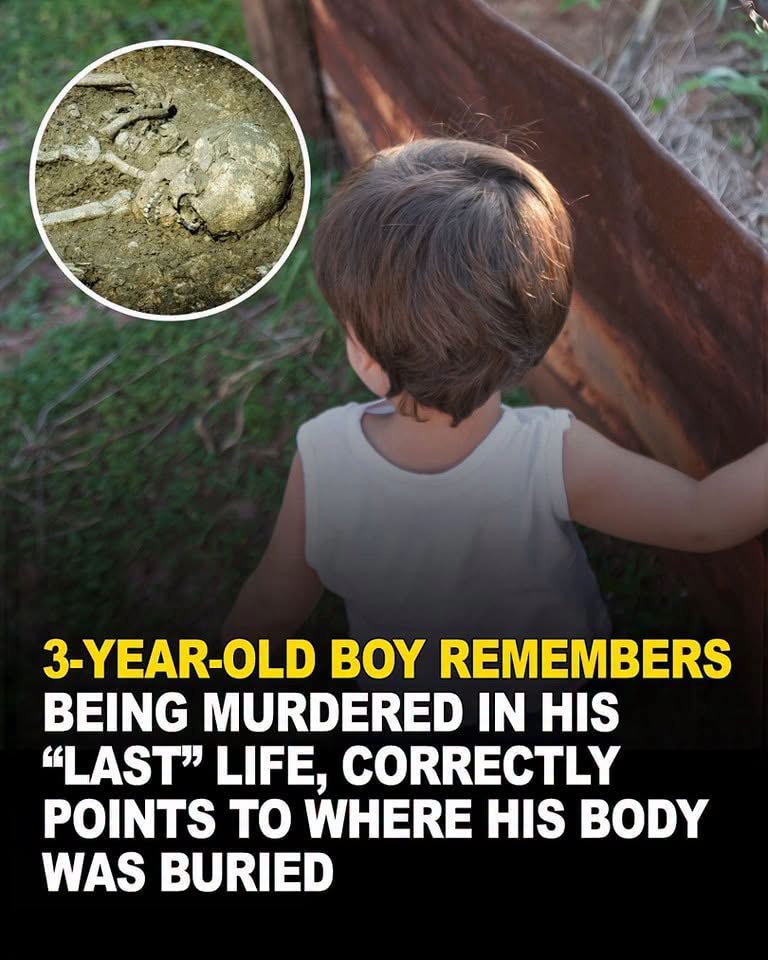
A three-year-old boy, barely old enough to string full sentences together, walked into his village and shattered the sanity of everyone he met. He didn’t just claim to remember a past life; he pointed to the exact spot where his own corpse had been rotting for years. He described the cold, metallic sting of an axe, the terror of his final breath, and the face of the man who ended his life. When the villagers dug into the earth at the boy’s insistence, they didn’t find a toy or a treasure—they unearthed a skeleton and a murder weapon that defied logic.
The boy, a member of the Druze community living in the Golan Heights near the Syrian-Israeli border, first shocked his parents by asserting that he had been murdered in a previous existence. While most toddlers are busy learning their colors or playing with blocks, this child was haunted by the memories of a man who had been wiped from the face of the earth. His claims were so specific and so unsettling that they reached the ears of Dr. Eli Lasch, a respected medical professional whose work in the region had earned him a reputation for grounded, clinical thinking.
Dr. Lasch, who had seen enough of the real world’s horrors in Gaza to be a hardened skeptic, was forced to confront something that slipped through the cracks of rational science. He documented the boy’s journey in startling detail, a story later immortalized by German author Trutz Hardo in his book, Children Who Have Lived Before: Reincarnation Today. The boy’s ability to pinpoint the location of his former remains was only the beginning; he also displayed a prominent, long red birthmark on his head. According to the deep-seated beliefs of his community, birthmarks are the final signatures left behind by fatal injuries sustained in a past life. The boy insisted that the mark was exactly where the axe had split his skull.
As the toddler’s memories continued to sharpen, he did the unthinkable: he named his killer. The atmosphere in the village became thick with tension as the boy led his parents and local elders to the site of the alleged crime. They followed his small, steady steps to a patch of ground, where they began to dig. As the soil was cleared away, the impossible became real. There, buried in the earth, lay a skeletal remains and the rusted head of an axe—the very weapon he had described in horrifying detail.
The confrontation that followed was like something pulled from a psychological thriller. When the accused man was brought face-to-face with the boy who remembered his death, his initial facade of stoic denial crumbled. Confronted by the undeniable evidence of the body and the weapon, the man reportedly broke down and confessed to the murder. The case remains one of the most haunting intersections of the spiritual and the forensic, a narrative that forces even the most cynical observer to pause and wonder: what do we truly know about the nature of the soul?
The Golan Heights case is not a singular anomaly. History is riddled with accounts of “past-life children” whose memories have been verified with chilling accuracy. Take the story of James Leininger, an American boy who, at an age when he should have been watching cartoons, was consumed by the mechanics of World War II fighter planes. He spoke of crashing in a burning aircraft and gave the name of his squadron and the carrier he served on. When his parents looked into his claims, they found they were not the product of a vivid imagination, but the life story of James Huston, a pilot who had died exactly as the boy described.
In the 1930s, Shanti Devi of India stunned her family by recounting the intimate details of a life lived in a distant city. She named her former husband, described the architecture of her old home, and even recalled the specific complications surrounding her death. Her testimony was so compelling that Mahatma Gandhi himself took an interest, commissioning an investigation that confirmed her account was not merely a fabrication.
The presence of birthmarks as physical evidence remains the most debated aspect of these phenomena. Dr. Ian Stevenson, a psychiatrist who dedicated his life to this research, interviewed thousands of children across the globe. He noted a recurring pattern: birthmarks and congenital deformities often aligned perfectly with the fatal wounds described by the children. From a Thai boy who remembered being a teacher shot in the head to a Burmese child who recalled dying from a bullet to the chest, the physical evidence seems to persist across lifetimes.
While these stories are often dismissed as cultural superstition, modern researchers like Dr. Jim Tucker from the University of Virginia are working to bridge the gap between these anecdotes and scientific inquiry. They argue that these memories might hint at a fundamental truth about consciousness—that it may exist as an independent entity, separate from the biological limitations of the brain. Some even draw parallels to the mysterious mechanics of quantum physics, where the observer and the observed exist in a state of interconnectedness that defies the linear passage of time.
Whether these cases are fragments of a previous life or a deeper, unexplained facet of the human psyche, they continue to challenge our understanding of death. They turn our attention away from the idea that we are simply products of our immediate environment and toward the possibility that we are travelers across a much longer timeline. For the boy in the Golan Heights, the mystery was settled when the earth gave up its secrets. For the rest of us, these stories remain a mirror, reflecting our own uncertainty about what happens when the final curtain falls and the next life begins. The evidence may be anecdotal, but the sheer weight of these accounts suggests that there is a vast, hidden architecture to human memory that science is only just beginning to map.