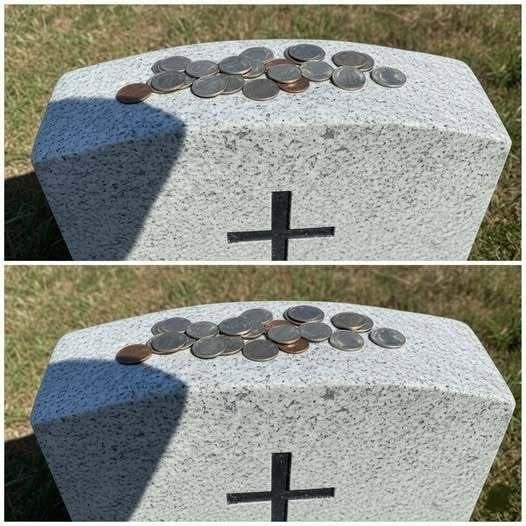
If you have ever visited a cemetery, especially one where military veterans are buried, you may have noticed something unusual resting on top of certain gravestones.
A small coin.
Sometimes it is a penny. Other times it may be a nickel, a dime, or a quarter.
To someone unfamiliar with the tradition, it might seem accidental. Perhaps a visitor dropped spare change or left it behind without thinking. Yet in many cases, those coins were placed intentionally.
For decades, leaving coins on military gravestones has served as a quiet and meaningful way to honor service members, express respect, and remember those who have passed away.
Though the tradition is simple, the symbolism behind it carries deep significance for many veterans, military families, and visitors.
A Tradition Rooted in Remembrance
Across cultures and throughout history, people have developed unique ways of honoring loved ones who are no longer with them.
Some leave flowers.
Others place flags, photographs, handwritten notes, or personal mementos.
In military cemeteries, coins became another form of remembrance.
The practice is often associated with veterans and members of the military community who wish to pay their respects to fellow service members.
Unlike flowers that eventually fade or paper notes that may deteriorate over time, coins are durable and recognizable.
Their presence immediately signals that someone took the time to visit and remember.
Why Coins Became a Symbol
One reason coins became associated with remembrance is their simplicity.
Almost everyone carries coins at some point.
They are small, accessible, and able to withstand weather and time.
More importantly, they provide a subtle way to communicate a message without words.
A coin resting on a gravestone can tell family members and visitors that someone came to pay their respects.
It serves as evidence that the individual buried there continues to be remembered.
For many families, especially those who may not be able to visit frequently, seeing coins left behind can bring comfort.
It demonstrates that their loved one’s memory remains important to others.
The Meaning Behind Different Coins
Over time, various interpretations developed regarding the significance of different coin denominations.
While traditions may vary between communities and regions, a commonly shared understanding assigns special meanings to specific coins.
The Penny
The penny is often considered the most basic symbol of remembrance.
Its message is simple:
“I visited.”
Leaving a penny indicates that someone stopped by to honor the individual buried there.
Though small in value, the gesture carries emotional significance.
It serves as a reminder that a person’s life and service continue to be remembered.
For many families, even this simple acknowledgment can mean a great deal.
The Nickel
A nickel is often associated with a shared experience during military training.
In many interpretations of the tradition, it suggests that the visitor and the deceased completed training together.
Military training often creates strong bonds among participants.
Individuals learn, struggle, and grow together through challenging experiences.
Leaving a nickel may symbolize those shared memories and the connection formed during that time.
The Dime
A dime is commonly understood to represent service together.
It suggests that the visitor served alongside the person being honored.
Whether through assignments, deployments, or other military experiences, the dime acknowledges a deeper connection formed through shared service.
It communicates respect not only for the individual but also for the experiences they shared together.
The Quarter
Among the commonly recognized interpretations, the quarter is often viewed as carrying the strongest message.
It is sometimes associated with being present during important moments in the service member’s life or final chapter.
For many people, leaving a quarter represents a particularly personal connection and a profound level of respect.
While interpretations vary, the overall message remains one of remembrance and honor.
More Than a Coin
Although these meanings are widely shared, the tradition is ultimately about intention rather than strict rules.
Not every visitor follows the same interpretation.
Some leave coins simply because they wish to show respect.
Others participate because they learned the custom from family members, veterans, or military organizations.
The value of the coin itself is not what matters.
The meaning behind the gesture is what gives it significance.
A single penny placed with sincerity can carry just as much emotional weight as any other tribute.
A Source of Comfort for Families
Many families discover coins on gravestones without initially understanding their significance.
Once they learn the tradition, those small pieces of metal often take on new meaning.
The coins become evidence that people continue to visit.
They become reminders that others still remember.
They become symbols of connection.
For parents, spouses, children, and friends, knowing that a loved one’s memory continues to be honored can provide comfort during difficult moments.
Even years after a funeral or memorial service, the presence of coins suggests that remembrance continues.
Preserving Military Bonds
Military service often creates relationships unlike any other.
Shared challenges, training, deployments, and experiences can form lifelong friendships and mutual respect.
The tradition of leaving coins reflects those enduring bonds.
Even after many years, veterans may visit the resting places of friends, colleagues, or fellow service members.
Placing a coin becomes a way of acknowledging that those connections remain important.
It is a quiet reminder that certain relationships continue beyond active service.
The Importance of Remembering
Remembrance plays an important role in every society.
Honoring those who served helps preserve history and recognize contributions that might otherwise fade from memory.
Traditions such as leaving coins encourage reflection.
They invite visitors to pause, consider a person’s life, and acknowledge their impact.
In a fast-moving world, these moments of reflection help ensure that important stories are not forgotten.
The coin becomes a small but meaningful symbol of that commitment.
A Tradition That Continues Today
The practice of leaving coins remains visible in many cemeteries throughout the United States and beyond.
Visitors continue to participate because the gesture is simple, respectful, and meaningful.
New generations learn about the tradition through family members, veterans’ organizations, and educational programs.
As awareness spreads, more people come to appreciate the significance behind what might otherwise appear to be an ordinary object.
The continued presence of coins on gravestones demonstrates the lasting power of remembrance.
Why Small Gestures Matter
One of the most remarkable aspects of this tradition is its simplicity.
It does not require elaborate planning.
It does not require expensive gifts or large public ceremonies.
Instead, it relies on a small action performed with intention.
History is filled with examples of meaningful traditions built upon simple gestures.
A flower.
A candle.
A handwritten note.
A coin.
The power comes not from the object itself but from the meaning attached to it.
A Quiet Symbol of Respect
The next time you notice a coin resting on a gravestone, you may see it differently.
Rather than spare change, it becomes a symbol.
A symbol of remembrance.
A symbol of respect.
A symbol of connection between the living and those who came before them.
Every coin tells a story.
Not necessarily through words, but through the simple act of being placed there.
It represents a visit.
A memory.
A shared experience.
Or a heartfelt tribute.
Final Thoughts
The tradition of leaving coins on gravestones reminds us that honoring others does not always require grand gestures.
Sometimes the most meaningful expressions of respect are also the simplest.
A small coin can communicate gratitude, remembrance, friendship, and honor in ways that words often cannot.
For families, veterans, and visitors alike, these coins serve as lasting reminders that memories endure.
Long after ceremonies end and years pass, the tradition continues—one coin, one visit, and one act of remembrance at a time.
In a world where so much changes, these small symbols help ensure that important lives and meaningful sacrifices are never forgotten