The Forgotten Kitchen Spoon That Has a Surprisingly Clever Purpose
A Mysterious Utensil Hidden in Plain Sight
Many households contain at least one kitchen tool that rarely gets used and is often overlooked. Tucked away in the back of a drawer, it may sit untouched for years while people wonder what it was originally designed to do.
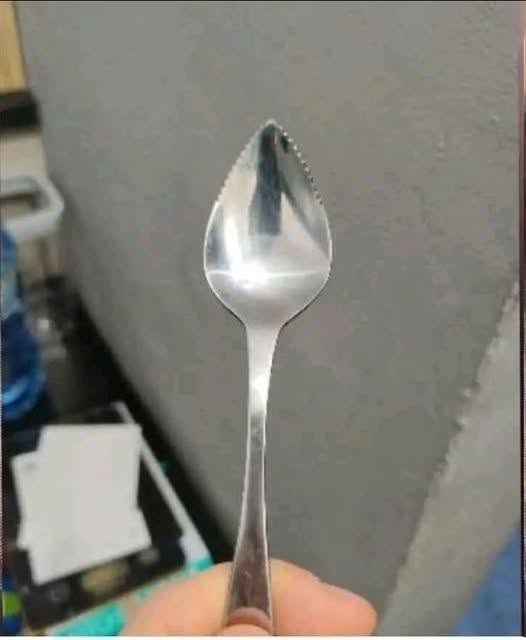
Among the most commonly misunderstood utensils is a small spoon with an unusual appearance. It resembles a regular spoon at first glance, but a closer look reveals a series of tiny teeth running along the edges.
Its design can seem strange, especially to people who have never seen one used properly. Some mistake it for a decorative serving piece, while others assume it belongs to an incomplete set of silverware.
In many cases, the utensil is ignored entirely or even discarded because its purpose is not immediately obvious.
Yet this modest kitchen tool was created to solve a very specific problem, and it does so remarkably well.
The Tool Known as a Grapefruit Spoon
The mysterious utensil is known as a grapefruit spoon. Although it looks similar to an ordinary spoon, its design includes features intended specifically for eating citrus fruit.
What sets it apart are the serrated edges lining the bowl of the spoon. These small teeth transform it from a simple scooping utensil into a tool capable of cutting and lifting fruit at the same time.
Unlike a standard spoon, which often slips across fruit membranes and struggles to separate sections cleanly, a grapefruit spoon is designed to work with the fruit’s natural structure.
The result is a smoother and more efficient eating experience.
Its appearance may not attract much attention, but its functionality has earned it a place in kitchens for generations.
Why Grapefruit Can Be Difficult to Eat
Anyone who has tried eating grapefruit with a regular spoon is familiar with the challenge. The fruit’s membranes can be tough enough to resist a smooth-edged utensil while remaining delicate enough to burst and release juice everywhere.
Many people find themselves pressing harder and harder with a standard spoon, only to tear apart the fruit and create a sticky mess.
Juice often spills onto plates, tables, and hands. Sections break apart unevenly, making the process more frustrating than enjoyable.
Even using a knife can create complications. Cutting individual segments often requires careful precision, and the process can feel unnecessarily time-consuming for a simple breakfast fruit.
These small inconveniences may seem minor, but they add up quickly when repeated over time.
The grapefruit spoon was developed specifically to eliminate those frustrations.
A Simple Design With a Practical Purpose
The genius of the grapefruit spoon lies in its simplicity. Rather than relying on complicated mechanisms or moving parts, it improves a familiar object with one thoughtful modification.
The serrated edges gently cut through the membranes that separate grapefruit segments. At the same time, the curved bowl lifts the fruit cleanly from the peel.
This allows users to separate sections neatly without crushing them or losing their shape.
The spoon effectively performs two tasks at once. It slices and scoops in a single motion.
Because of this dual function, eating grapefruit becomes significantly easier and less messy.
What once required patience and careful handling can be accomplished with minimal effort.
The Difference Great Design Can Make
Many successful inventions share a common characteristic: they solve a problem so effectively that people stop noticing the problem ever existed.
The grapefruit spoon belongs to this category of design.
It does not dramatically transform a kitchen or attract attention with advanced technology. Instead, it quietly improves a routine activity.
By addressing a specific frustration, it makes a familiar task more pleasant.
That kind of practicality often goes unnoticed because the improvement feels natural once experienced.
People who use a grapefruit spoon for the first time are often surprised by how much easier the process becomes.
The fruit separates cleanly, the juice remains more contained, and the overall experience feels smoother.
It is a small change, but one that many users quickly appreciate.
A Common Item in Earlier Generations
For many decades, grapefruit spoons were a familiar feature in household silverware collections.
They were especially common in homes where citrus fruits regularly appeared on breakfast tables.
Families often owned complete sets that included specialized utensils for various dining purposes.
During that period, the grapefruit spoon was not considered unusual. It was simply another practical tool designed to make a specific task easier.
As years passed and eating habits evolved, however, the utensil gradually became less common in everyday use.
Many younger people inherited drawers full of silverware without receiving explanations about every piece.
As a result, grapefruit spoons often lost their identity.
They remained in kitchens, but their purpose was forgotten.
Rediscovering a Forgotten Utensil
In recent years, curiosity about unusual kitchen tools has grown.
People sorting through inherited utensils frequently encounter grapefruit spoons and wonder what they are.
The distinctive teeth immediately attract attention.
Many individuals struggle to understand why a spoon would need sharp edges.
Questions about these mysterious utensils often spark conversations among family members who remember using them decades ago.
Others discover their purpose through online discussions, where forgotten household tools regularly become topics of interest.
These moments of rediscovery have introduced the grapefruit spoon to a new generation.
For many people, learning its purpose creates an immediate sense of appreciation for the thoughtful design.
Useful for More Than Grapefruit
Although the utensil is known as a grapefruit spoon, its usefulness extends well beyond citrus fruit.
Its serrated edges make it effective for a variety of soft fruits that can be difficult to handle with conventional utensils.
Kiwi is one example. The spoon can easily separate the flesh from the skin while preserving the fruit’s texture.
It also works well with passion fruit, allowing users to scoop out the interior without difficulty.
Peaches and mangos can benefit from the spoon’s ability to trace around pits and lift soft flesh cleanly.
Oranges and similar fruits can also be enjoyed more easily when the spoon is used to separate segments.
Even avocados can sometimes be handled more effectively thanks to the combination of cutting and scooping capabilities.
This versatility helps explain why many people continue using grapefruit spoons long after discovering them.
Why People Grow Attached to Them
There is something appealing about tools that perform a single task exceptionally well.
Unlike large kitchen gadgets that occupy valuable storage space, a grapefruit spoon is compact, durable, and easy to use.
It requires no setup, maintenance, batteries, or instructions.
Its purpose becomes obvious once it is placed in the right situation.
That simplicity often creates a sense of appreciation.
People who initially dismissed the utensil as unnecessary frequently change their minds after using it.
What seemed like an odd specialty item suddenly becomes a preferred tool.
The experience of removing a perfect fruit segment without tearing it apart can be surprisingly satisfying.
As a result, many users begin reaching for the spoon more often than expected.
The Appeal of Practical Innovation
Modern kitchens are filled with products that promise convenience and efficiency.
Many are heavily marketed and designed to appear revolutionary.
Yet some of the most enduring innovations are far simpler.
The grapefruit spoon demonstrates that meaningful improvement does not always require complexity.
Sometimes a small adjustment to an existing object can create a noticeably better experience.
The addition of serrated edges transformed an ordinary spoon into a highly specialized and effective tool.
Its continued usefulness shows how thoughtful design can remain relevant for generations.
Rather than replacing familiar objects, it refines them.
That approach often produces solutions that stand the test of time.
A Reminder Hidden in the Kitchen Drawer
Many forgotten household items tell stories about changing habits and evolving lifestyles.
The grapefruit spoon is one such example.
It reflects a period when specialized utensils were more common and when simple mechanical solutions were often preferred over complicated alternatives.
Despite becoming less visible in daily life, the utensil never lost its effectiveness.
Its purpose remains exactly the same today as it was decades ago.
Whenever someone rediscovers one in a drawer, they are often surprised to learn that the strange-looking spoon was never decorative or accidental.
Every detail of its design serves a practical function.
The tiny teeth, unusual shape, and compact size all contribute to its ability to handle fruit efficiently.
Once that purpose becomes clear, the utensil suddenly makes perfect sense.
A Small Tool With Lasting Value
The grapefruit spoon may not be the most famous kitchen invention, but its clever design continues to earn admiration from those who use it.
It represents the kind of practical innovation that quietly improves everyday life without demanding attention.
Its effectiveness comes not from complexity but from understanding a simple problem and providing a straightforward solution.
For decades, it helped people enjoy grapefruit and other fruits with less effort and less mess.
Even today, it remains a useful addition to any kitchen.
Many people spend years overlooking the utensil before finally discovering what it was created to do.
Once they understand its purpose, they often wonder how such a small object could make such a noticeable difference.
That reaction speaks to the strength of thoughtful design.
Sometimes the most impressive inventions are not the largest, most expensive, or most technologically advanced.
Sometimes they are the quiet tools waiting patiently in the back of a drawer, ready to prove their value the moment someone finally gives them a chance.