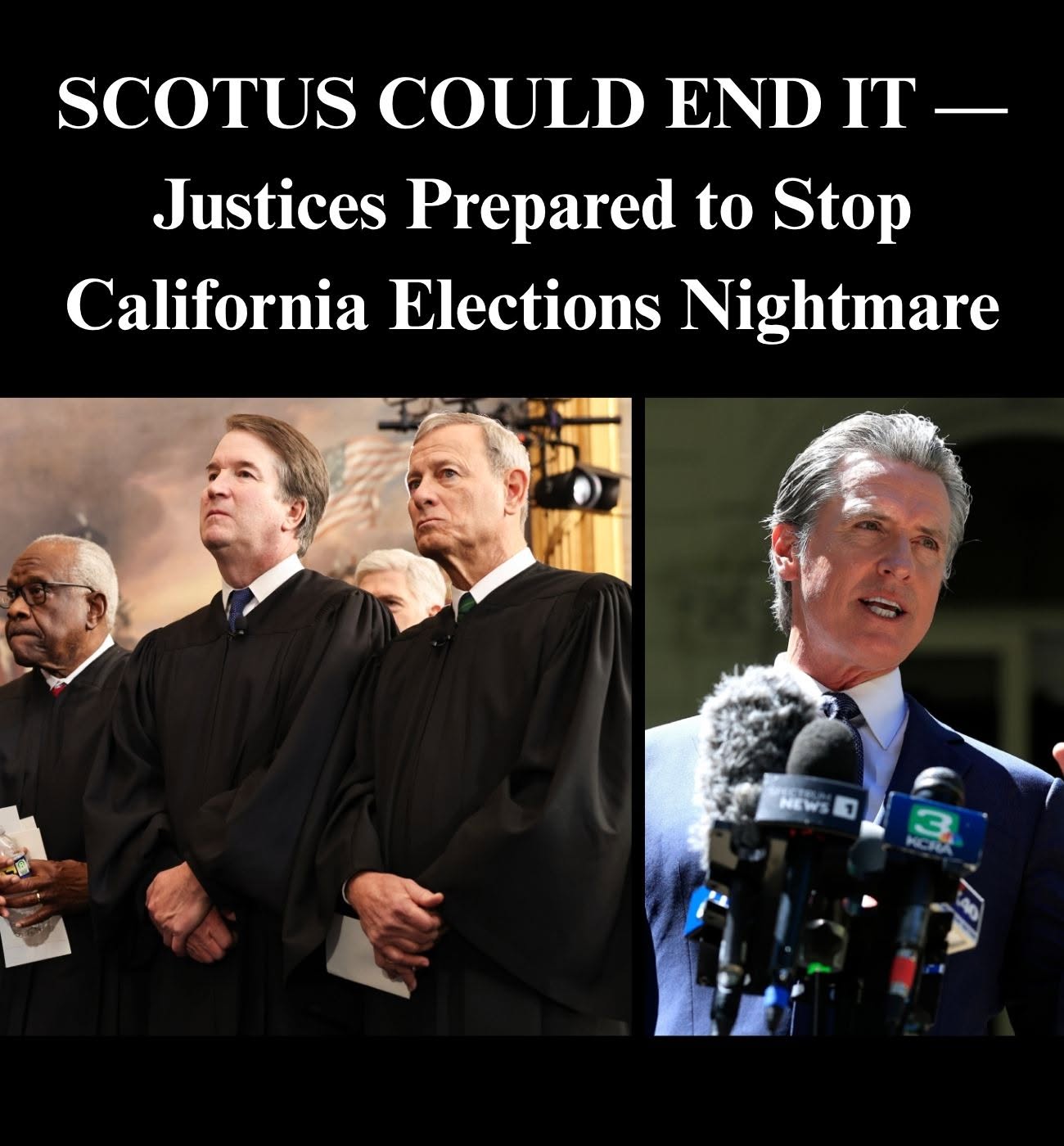
A closely watched case now before the U.S. Supreme Court could have major implications for election administration across the country, including in California and more than a dozen other states that continue counting certain mail ballots after Election Day.
The case, Watson v. Republican National Committee, centers on whether federal law permits states to count ballots that arrive after Election Day if they were mailed on or before Election Day.
The justices heard oral arguments in March and are expected to issue a decision before the end of the Court’s current term this month.
At issue is a Mississippi law that allows absentee ballots to be counted if they are postmarked by Election Day and received within five business days afterward.
Republican challengers argue that the law conflicts with federal statutes establishing a uniform national Election Day for presidential, U.S. Senate, and U.S. House elections.
Their position is straightforward: federal law sets a single Election Day, meaning ballots must be received by then to be counted.
Mississippi officials argue that states retain broad authority over election administration and that ballots cast by Election Day should still be valid if they arrive shortly afterward.
The dispute began after Mississippi enacted House Bill 1521 in 2020 during the COVID-19 pandemic. The law created a five-day grace period for absentee ballots arriving after Election Day.
In 2024, the Republican National Committee and other plaintiffs challenged the law in federal court.
While a federal district court initially upheld Mississippi’s policy, the U.S. Court of Appeals for the Fifth Circuit later ruled that federal election law preempts the state’s post-Election Day ballot receipt window.
Mississippi appealed to the Supreme Court, which agreed to hear the case last year.
The stakes extend far beyond Mississippi.
According to election law data, roughly 15 states and the District of Columbia currently allow at least some ballots to arrive after Election Day and still be counted, provided they meet postmark requirements.
That includes California, where mail ballots can be counted if they are postmarked by Election Day and received within the state’s statutory deadline of seven days afterward.
A ruling for the challengers could force states to require receipt of ballots by Election Day for all federal elections.
Supporters of that approach argue it would create a clearer and more uniform national standard while reducing prolonged ballot-counting periods that can leave election outcomes unresolved for days or even weeks.
Critics argue that such a ruling could disenfranchise voters who mail ballots on time but experience postal delays outside their control.
During oral arguments, several justices appeared focused on the meaning of federal statutes establishing a single national Election Day. Court observers noted significant questioning about whether votes received after Election Day are consistent with Congress’s decision to establish one uniform federal election date.
No decision has been issued yet, and it remains unclear how the Court will ultimately rule.
However, the outcome could become one of the most consequential election-law decisions in years.
A ruling for the challengers would likely require states to revise ballot-receipt deadlines for federal elections and could substantially reduce post-Election Day vote counting nationwide.
A ruling for Mississippi would preserve existing state flexibility and allow current ballot-receipt grace periods to remain in place.
With the 2026 midterm elections approaching, election officials, political parties, and voting-rights organizations across the country are closely watching the case.
The Court’s decision is expected before the end of June and could establish a nationwide standard governing when ballots must be received in federal elections for years to come.
While the legal dispute began in Mississippi, the Supreme Court’s ruling could have implications far beyond one state’s election laws.
Currently, a significant number of states permit some form of post-Election Day ballot receipt period. Under these systems, ballots are counted as long as they were mailed by Election Day and arrive within a specified number of days afterward.