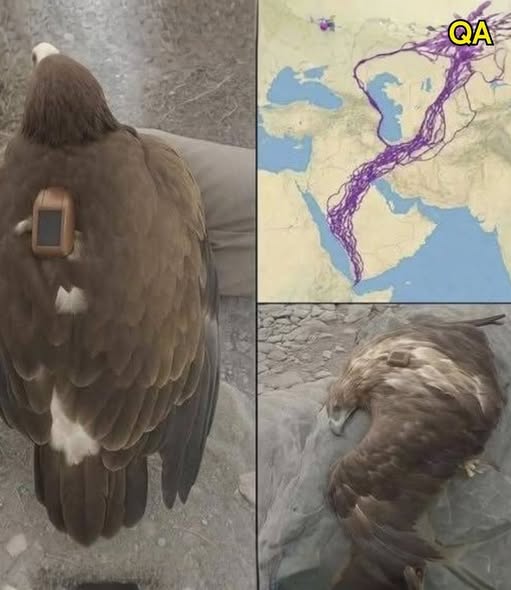
Every so often, a story from the natural world captures global attention not because of danger or drama, but because it reveals something remarkable about life on Earth. One such story involved a migrating eagle fitted with a GPS tracker whose movements were monitored for nearly two decades. What began as a routine wildlife research project eventually became one of the most fascinating examples of avian navigation and survival ever documented.
Scientists originally attached the lightweight tracking device to better understand migration behavior in large birds of prey. Eagles are already known for traveling enormous distances during seasonal migrations, but researchers did not expect this single bird to provide such a detailed long-term portrait of instinct, adaptation, and environmental intelligence.
Over the years, the eagle’s repeated journeys revealed migration routes stretching across vast regions between northern Asia and warmer southern territories. The consistency and precision of the bird’s travel patterns amazed researchers and inspired widespread public interest around the world.
A Migration Defined by Strategy
One of the most fascinating discoveries was that the eagle rarely followed the shortest possible route between destinations. Instead, the bird repeatedly chose paths shaped by geography, climate, and survival efficiency.
At first glance, people might assume flying in a straight line would save time and energy. However, scientists explained that survival in nature depends less on speed and more on efficiency and risk management.
The eagle consistently avoided large stretches of open ocean and instead followed coastlines, valleys, mountain ranges, and land corridors that supported safer flight conditions.
Researchers noted that these choices reflected highly refined instinctive behavior developed through generations of evolution.
Why Eagles Avoid Crossing Large Oceans
To understand the eagle’s behavior, scientists pointed to the mechanics of flight used by large birds of prey.
Eagles rely heavily on thermals — rising columns of warm air created when sunlight heats the ground. These thermals allow birds to glide for long distances while conserving energy rather than constantly flapping their wings.
Over large bodies of water, thermals are weak or often nonexistent.
Crossing open seas would force the eagle to rely on continuous wing movement, dramatically increasing energy use and exhaustion risk. By remaining close to land, the bird could conserve strength and travel far more efficiently.
This strategy demonstrated how migration patterns are shaped not by randomness, but by a deep biological understanding of environmental conditions.
What the GPS Data Revealed
The long-term tracking data painted an extraordinary picture of the eagle’s interaction with its environment.
Researchers observed that the bird:
- Used mountain ranges to gain altitude
- Followed predictable thermal patterns
- Adjusted routes according to seasonal weather
- Selected safe resting locations
- Avoided dangerous environmental conditions
Over time, the migration route appeared less like a simple path and more like a carefully designed system optimized for endurance and survival.
Scientists studying bird migration described the eagle’s consistency as a remarkable example of natural adaptation and navigational intelligence.
The Science Behind Bird Navigation
Bird migration remains one of the most impressive natural phenomena studied by biologists.
Research suggests that migrating birds use a combination of navigation methods, including:
- Earth’s magnetic field
- Visual landmarks
- Solar positioning
- Wind patterns
- Environmental memory
- Instinctive behavioral patterns
In long-lived birds such as eagles, repeated migration journeys may also strengthen learned route familiarity over time.
The decades-long data collected from this eagle provided scientists with valuable insight into how instinct and experience work together in migratory species.
Why the Story Captured Public Attention
Although the research itself was scientifically important, the story resonated far beyond academic circles because people connected emotionally with the eagle’s journey.
Many viewers saw the migration as symbolic of perseverance, awareness, and resilience. The idea of one bird repeatedly crossing continents while navigating changing climates and landscapes inspired fascination and admiration.
Unlike many viral stories based on shock or controversy, this one reflected quiet endurance and the extraordinary intelligence already present within the natural world.
Eagles as Powerful Cultural Symbols
Across many cultures throughout history, eagles have represented strength, vision, independence, and perspective.
Their ability to soar high above landscapes has often made them symbols of wisdom, clarity, and spiritual connection. Ancient civilizations frequently viewed eagles as messengers between earth and sky.
This cultural symbolism helped deepen public interest in the tracked bird’s story. While scientists focused on migration data, many people interpreted the eagle’s journey as a broader metaphor for resilience and thoughtful navigation through life’s challenges.
Technology’s Role in Wildlife Research
The story also highlighted how modern tracking technology has transformed wildlife research.
Lightweight GPS devices now allow scientists to study animal movement with remarkable accuracy while minimizing disruption to natural behavior. These tools help researchers identify migration corridors, monitor environmental changes, and better understand how ecosystems connect across countries and continents.
The information gathered from tracking projects supports conservation efforts and helps protect important habitats used by migrating species.
Lessons From the Eagle’s Journey
Many people found meaningful lessons within the eagle’s migration patterns.
The bird’s behavior demonstrated that:
- The shortest path is not always the safest
- Careful energy management supports long-term survival
- Environmental awareness matters
- Adaptation is essential for resilience
These themes resonated strongly because they mirror challenges humans often face in everyday life.
A Reminder About Nature’s Complexity
Ultimately, the story reminded people how much remains to be learned from the natural world. What appeared at first to be a simple migration study evolved into a deeper understanding of instinct, environmental balance, and biological intelligence.
The eagle’s journey showed that survival in nature depends not only on strength, but also on patience, awareness, and strategic adaptation.
Conclusion
For nearly twenty years, one migrating eagle quietly crossed continents while scientists followed its movements through GPS technology. What they discovered was far more than a flight path — it was a remarkable example of how animals interact intelligently with their environments in ways humans are still working to fully understand.
The story captivated audiences because it combined science, mystery, endurance, and the timeless beauty of nature. It also served as a reminder that extraordinary lessons often come not from dramatic events, but from observing the steady rhythms of the natural world with patience and curiosity.
Sometimes the most powerful discoveries are not about changing nature — but learning to pay closer attention to it.