Why Do People Throw Sneakers Over Power Lines? Theories Behind a Long-Standing Mystery
A Curious Sight That Still Raises Questions
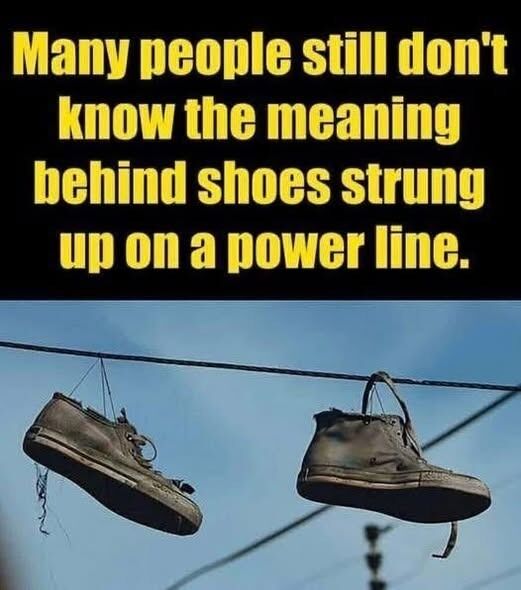
Few street sights are as instantly recognizable and mysterious as a pair of sneakers hanging from a power line. Suspended high above roads, sidewalks, and neighborhoods, these dangling shoes have sparked curiosity for decades.
While they may be less common than in previous years, they can still be found in cities, suburbs, and small towns. Their appearance often prompts the same question: why are they there?
Over time, numerous explanations have emerged. Some are rooted in tradition, others in rumor, and many in popular culture. The truth is that there is no single reason behind every pair of shoes hanging overhead.
Instead, the phenomenon appears to have multiple origins, varying from place to place and generation to generation.
A Tradition Linked to Major Life Changes
One of the oldest explanations connects the practice to military service. According to this theory, soldiers would throw their boots onto power lines after completing their service or reaching an important milestone in their military careers.
The act symbolized the end of one chapter and the beginning of another. By leaving their boots behind, individuals marked a transition from military life back to civilian life.
Over time, this story became widely shared and is often cited as one possible origin of the tradition.
Although it is difficult to verify how widespread the practice actually was, the symbolism remains compelling. The image of discarded footwear hanging overhead can easily be interpreted as a visual marker of change, achievement, or departure.
Whether common or not, the military explanation continues to be one of the most frequently discussed theories surrounding the phenomenon.
The Persistent Gang Territory Theory
Perhaps the most widely repeated explanation is the claim that shoes hanging from power lines indicate gang territory or locations connected to illegal activity.
According to this belief, the shoes act as markers used to communicate ownership of a neighborhood or identify places where drugs are sold.
The idea has appeared in conversations, news reports, and popular culture for many years. As a result, many people automatically associate dangling sneakers with criminal activity.
However, despite the popularity of this explanation, there is little solid evidence supporting it as a universal meaning.
Experts and community observers have frequently noted that the gang symbolism theory often relies on anecdotal stories rather than documented proof. In many locations where shoes are found hanging from wires, there is no verified connection to gangs or drug operations.
As a result, this explanation is often viewed as an urban legend rather than a reliable interpretation of every instance.
The Influence of Movies and Television
Popular culture has played a significant role in shaping public perceptions of hanging sneakers.
Films and television shows have frequently used the image as a storytelling device, often linking it to bullying, neighborhood conflict, or youthful pranks.
In some fictional stories, a character’s shoes are taken and thrown onto a power line as an act of humiliation. The image becomes a visual symbol of embarrassment, social exclusion, or loss.
These portrayals have helped reinforce the idea that dangling sneakers carry a hidden message or dramatic backstory.
Yet outside of fiction, evidence supporting bullying as a primary cause remains limited. While such incidents may occasionally occur, there is little data suggesting they account for most shoes found on utility wires.
Nevertheless, the connection remains deeply embedded in popular imagination because of its repeated appearance in entertainment media.
Mischief, Dares, and Youthful Fun
In many communities, the explanation may be far simpler than people expect.
For some teenagers and young adults, tossing sneakers over a power line is simply an act of playful mischief. It may happen during a gathering of friends, after a challenge, or as part of an informal tradition among peers.
The appeal often lies in the difficulty of the task. Successfully wrapping shoelaces around a wire and leaving the shoes suspended can feel like an achievement in itself.
Once a pair of sneakers appears on a line, others may follow. The sight can inspire imitation, turning a one-time prank into a recurring local trend.
In these cases, the shoes carry no deeper meaning. They simply represent a moment of fun, spontaneity, or youthful experimentation.
This explanation is often considered one of the most common reasons behind the phenomenon.
A Form of Local Identity and Expression
Beyond pranks and traditions, some people view hanging sneakers as a form of cultural expression.
In certain neighborhoods, the shoes become part of the local landscape and take on symbolic meaning over time.
Residents may see them as markers of community identity, reminders of shared experiences, or expressions of individuality. What begins as a simple act can gradually acquire cultural significance through repetition and familiarity.
Others interpret the sight as a subtle form of rebellion against social norms or authority. The shoes represent an unexpected alteration of everyday space, transforming ordinary utility wires into something visually distinctive.
Whether intentional or not, the result often creates a unique visual feature that becomes associated with a particular area.
This perspective highlights how everyday objects can acquire meanings that extend beyond their original purpose.
The Safety Risks Often Overlooked
While the mystery surrounding hanging sneakers can be fascinating, the practice is not without risks.
Power lines and utility equipment are critical parts of electrical infrastructure. Objects thrown onto these systems can create complications that go beyond simple inconvenience.
Shoes, laces, and other materials may become tangled in electrical equipment or interfere with maintenance operations.
Utility workers tasked with repairing or inspecting power lines can face additional challenges when foreign objects become entangled overhead.
There is also the risk that individuals attempting to throw shoes may come dangerously close to electrical equipment or engage in unsafe behavior while trying to retrieve them.
For these reasons, utility companies and safety organizations generally discourage the practice.
Responsible Alternatives for Old Footwear
Rather than throwing unwanted sneakers onto power lines, there are safer and more practical options available.
Many communities offer donation programs that accept gently used footwear. These programs can help provide shoes to individuals and families who need them.
Recycling initiatives may also accept worn-out sneakers, allowing materials to be repurposed rather than discarded.
Choosing donation or recycling not only avoids safety concerns but also gives old footwear a useful second life.
These alternatives support environmental responsibility while benefiting others in the community.
They represent a more constructive way to part with shoes that are no longer needed.
A Mystery With Many Possible Meanings
The enduring fascination with sneakers hanging from power lines stems from the fact that there is no single explanation that fits every situation.
For some, the shoes may represent a personal milestone. For others, they may be the result of a prank, a dare, or a local tradition. In certain cases, they may simply be random acts with no intended symbolism at all.
The variety of theories has helped keep the mystery alive for generations, allowing each sighting to inspire new questions and interpretations.
What remains clear is that the image continues to capture attention because it transforms an ordinary object into something unexpected and thought-provoking.
Looking Beyond the Legend
Sneakers hanging from power lines occupy a unique place in modern folklore. Their appearance has inspired stories involving soldiers, gangs, teenagers, artists, and communities, often with little certainty about which explanation applies.
While the symbolism may vary, the practical reality is that throwing shoes onto utility lines can create unnecessary safety risks and should not be encouraged.
The phenomenon remains an intriguing cultural curiosity, but it is best appreciated from a distance rather than recreated.
Whether viewed as a relic of local traditions, a piece of urban mythology, or simply a playful act, dangling sneakers continue to remind us how ordinary objects can become part of enduring public mysteries.