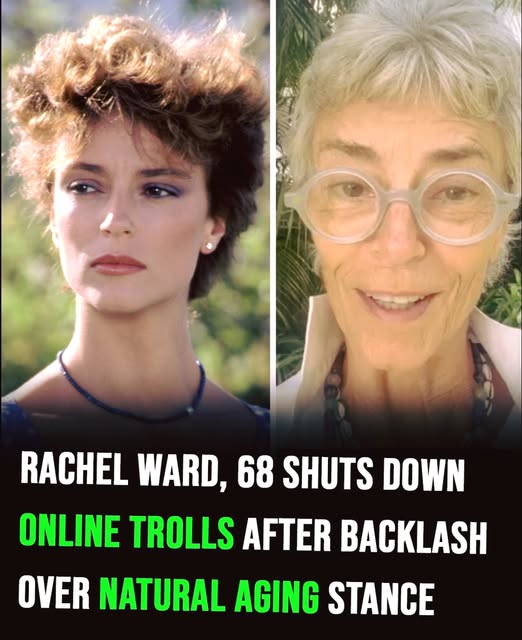
Rachel Ward first rose to international recognition after her breakout performance as Maggie Cleary in the acclaimed television miniseries The Thorn Birds. The role positioned her at the center of global attention and firmly established her as a recognizable figure in the entertainment industry. At the time, Ward’s performance was widely discussed for its emotional depth and screen presence. She quickly became associated not only with acting talent but also with the glamour and visual expectations that often accompany Hollywood visibility and international fame.
However, as her career developed, Ward gradually stepped back from the constant demands of mainstream celebrity life. Rather than continuing to pursue high-profile roles, she shifted her focus toward a more private and personally grounded lifestyle outside the constant media spotlight. In recent years, Ward has attracted renewed public attention not through acting roles, but through her openness about aging and appearance. In an interview with ABC News, she appeared without makeup and spoke candidly about societal expectations placed on women as they grow older.
During the interview, she addressed long-standing cultural pressure that encourages women in the public eye to maintain a youthful appearance at all costs. She questioned why aging is often treated as something to be hidden rather than a natural stage of life. Ward reflected on how public attitudes toward aging have evolved, noting that earlier generations of actresses were often judged harshly for visible signs of age. She suggested that this pressure has influenced how women perceive themselves both in public and private life.
She also discussed her involvement in new personal and professional directions, including a quieter lifestyle that reflects her shift away from traditional entertainment industry routines. This transition has allowed her to focus on projects aligned with her current values and interests. Following the interview, Ward’s natural appearance generated widespread discussion on social media platforms. While many viewers praised her honesty and confidence, others focused primarily on her physical appearance rather than her message or work.
Ward responded to the online attention with calm and direct remarks in a follow-up video shared on Instagram. She addressed criticism without hostility, emphasizing acceptance of natural aging and encouraging a more realistic view of beauty over time. In her comments, she highlighted the contradiction between public expectations and real-life aging. She pointed out that authenticity often receives mixed reactions, even when it reflects ordinary human experience shared by everyone.
She also referenced her ongoing life changes, including a shift toward more personal projects outside of traditional film and television work. This transition reflects a broader pattern of artists redefining their identity beyond early career fame.
Ward’s message centered on the idea that aging should not be viewed as something negative or shameful. Instead, she suggested it can be understood as a natural continuation of life experience rather than a decline in value or relevance.
Her perspective aligns with a growing global conversation about representation, especially for women in media and entertainment. Many public figures have begun challenging long-standing beauty standards and expectations associated with visibility and success.
Supporters of Ward’s stance praised her willingness to appear publicly without heavy styling or makeup. They viewed her approach as a form of honesty that challenges unrealistic expectations often placed on women in the public eye. Critics, however, focused more on appearance-based commentary, reflecting ongoing tensions in how aging and authenticity are perceived in digital spaces. This divide highlights broader cultural debates about image, identity, and public scrutiny.
Despite mixed reactions, Ward maintained a composed and consistent message. She emphasized that personal comfort and self-acceptance matter more than external approval, particularly in later stages of life and career.
Her statements also encouraged broader reflection on how society discusses aging in general. She suggested that normalizing natural changes could reduce pressure and improve how individuals relate to their own self-image over time.
Ward’s journey from international acting recognition to reflective public commentary illustrates a shift from performance-based identity to personal authenticity. Her current focus appears centered on lived experience rather than external validation. Ultimately, Rachel Ward’s message is not only about appearance, but also about autonomy and acceptance. Her public reflections contribute to a wider conversation about aging, identity, and the freedom to exist without constant performance for others.