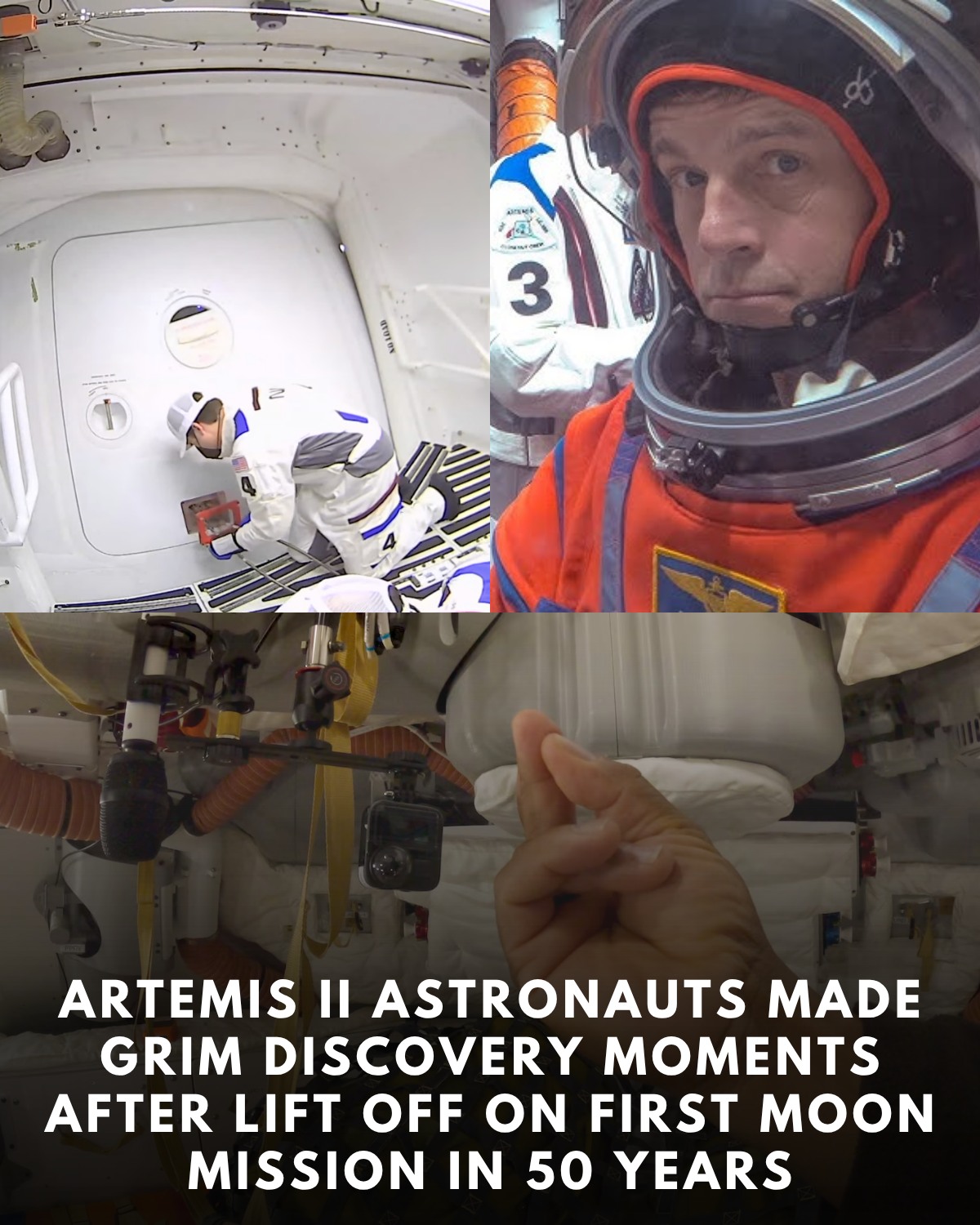
Hours after launching astronauts toward the Moon for the first time in more than half a century, NASA found itself dealing with an issue far more ordinary than the scale of the mission itself: Orion’s toilet had developed a fault.
The problem emerged during the first hours of Artemis II, NASA’s 10-day crewed lunar flyby, after the four-person crew had reached orbit and begun setting the spacecraft up for life in space. In an official mission update, NASA said the astronauts reported a blinking fault light during a checkout of the toilet ahead of an apogee raise burn, with teams on the ground then working with the crew to identify and resolve the issue. By early Thursday, NASA said Orion’s toilet had been restored to normal operations following the spacecraft’s proximity operations demonstration.
It was a small glitch in the context of a mission of enormous historical weight, but it was not a trivial one. Artemis II is the first crewed flight of the Orion spacecraft and the first time people have travelled beyond low-Earth orbit since Apollo 17 in 1972. The mission is designed not simply to reach the Moon and return, but to prove that Orion’s systems can sustain a crew in deep space, where there is no quick rescue option and no margin for basic life-support failures. NASA itself has framed Artemis II as a test mission, with astronaut Christina Koch saying in a NASA podcast before launch: “The Artemis II mission at its heart is a test mission of the Orion space capsule. This is going to be the first time that humans have ridden inside that capsule and that everything on board keeps us alive.”
That is why a toilet problem, however easy it may be to joke about online, matters on a flight like this. Orion is not the International Space Station, with room, redundancy and a larger supply base. It is a tightly packed vehicle, built for a crew of four to live and work in deep space for roughly 10 days. NASA says Artemis II launched on April 1 and will send commander Reid Wiseman, pilot Victor Glover, mission specialist Christina Koch and Canadian mission specialist Jeremy Hansen on a free-return trajectory around the Moon and back to Earth. The spacecraft, named Integrity by the crew, is expected to travel for 10 days and carry the astronauts farther from Earth than any humans have been in more than 50 years.
Unlike the Apollo astronauts, this crew at least has a dedicated toilet. That alone marks a major technological and human-factors change. NASA’s Orion spacecraft includes what it calls a hygiene bay, and NASA has previously said the system aboard Artemis II is based on the Universal Waste Management System first introduced on the International Space Station. The agency has described it as more compact and more efficient than earlier space toilets, and Orion’s design includes a private bathroom area rather than the far more rudimentary methods used during Apollo missions, when astronauts relied on bags and other awkward procedures. NASA has said Orion’s hygiene bay includes “a new compact toilet,” while NASA engineer Branelle Rodriguez explained in the agency’s Curious Universe podcast that the toilet sits in a private area just below where astronauts enter the capsule. “There is a door,” she said. “We do respect privacy.”

Rodriguez also explained how the system is supposed to work in practice. In microgravity, astronauts must secure themselves with handrails and tethers. She said liquid waste is vented out of the spacecraft, “very similar to how Apollo also did it,” while solid waste is stored in what she called a fecal collection container, using filters to help control odours. That arrangement is functional, but it also underlines why any malfunction needs attention quickly. Artemis II is not just a voyage around the Moon. It is a live demonstration of whether Orion can support a crew under real conditions, with all the mundane realities of human life included.
NASA did not indicate that the problem posed a broader threat to the crew or to the mission timeline. Its updates suggested the issue was contained and then resolved, with the astronauts continuing through a series of major early-mission tasks, including orbit-raising manoeuvres and a proximity operations demonstration using the interim cryogenic propulsion stage after separation. That work is central to Artemis II’s purpose. NASA has said Orion must prove it can be flown and managed with humans aboard in the actual environment of deep space, validating systems and procedures before later Artemis missions attempt more ambitious objectives.
The people onboard are central to the symbolism of the mission as well as its engineering aims. Wiseman is a former chief astronaut and veteran spaceflyer. Glover is the first Black astronaut assigned to a lunar mission. Koch is the first woman assigned to a mission around the Moon. Hansen, from the Canadian Space Agency, is the first non-American assigned to such a flight. Reuters reported that each represents a milestone in the history of crewed lunar exploration, and NASA has presented the four as the team that will help reintroduce humanity to deep-space travel after a gap of more than five decades.
That broader significance has always been part of how NASA has sold the mission. On its Artemis II mission page, the agency says the flight is a key step toward a long-term return to the Moon and future missions to Mars. The mission follows the uncrewed Artemis I test flight in 2022, when Orion flew around the Moon without astronauts aboard. Now, with a crew inside for the first time, every system becomes more consequential. Reid Wiseman said in NASA’s podcast that when you get inside Orion, “you start to realize the depth of thought that has gone into everything,” adding that “every lesson that has ever been learned in human spaceflight has been rolled into Orion.” The toilet issue, and the speed with which NASA moved to resolve it, became an early reminder that even after years of design, testing and simulation, first crewed flights still reveal things that only real missions can.
In that sense, the episode may end up being remembered less as an embarrassment than as proof that Artemis II is doing exactly what it was supposed to do. Test missions exist to expose weakness, verify backup plans and force teams on the ground and in flight to solve problems in real time. NASA’s official account is that Orion’s toilet is now back to normal operation. The mission continues toward the Moon, and with it a programme meant to carry the United States and its partners deeper into space than they have gone since the Apollo era. For all the grandeur surrounding Artemis II, one of its first lessons has been strikingly simple: even on a mission built to reopen the road to the Moon, the basics still matter.