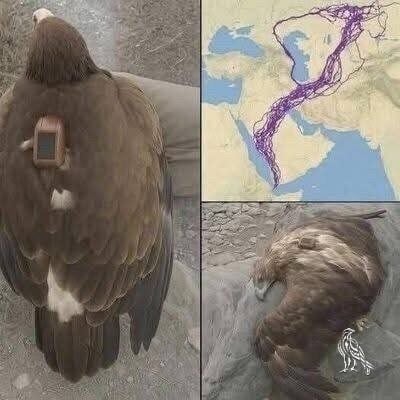
What began as a simple tracking project slowly transformed into a humbling lesson in how little we understand the living world. The eagle’s looping, jagged routes, once dismissed as noise or error, emerged as a map of survival—its movements finely tuned to shifting winds, fleeting thermals, and invisible corridors of safety and food. The bird was not lost; it was listening to a landscape too complex for human intuition.
As researchers layered weather charts, wind models, and terrain data over the GPS trail, a hidden logic surfaced. Every detour had a reason, every pause a purpose. The eagle’s journey challenged the comfort of neat migration arrows on classroom maps and replaced them with something messier, but more honest: life adapting in real time. In that tangled path, scientists saw not confusion, but intelligence woven into the air itself.